
How to Get Paid on Time as a Tradesman
Getting paid late is not bad luck. It’s usually a symptom of a system that makes it too easy for customers to delay. Most tradespeople who struggle with late payment have no written payment terms, don’t ask for deposits, send invoices days after completing work, and feel uncomfortable chasing. Fix those four things and your cash flow changes entirely.

This guide covers exactly how to build a payment system that gets money in on time, every time – without damaging your customer relationships.
Why Late Payment Is a Business Problem, Not a People Problem
It’s tempting to blame late-paying customers as individuals. Some genuinely are difficult. But most are simply operating in the absence of a clear system that tells them when and how to pay.
Consider two scenarios:
Scenario A: You finish a job on Friday. You send an invoice the following Monday. The invoice says “payment within 30 days.” No deposit was taken. You don’t follow up until week three.
Scenario B: You take a 25% deposit before starting. You finish the job on Friday and send the invoice that afternoon. It says “payment due on completion – bank details below.” You follow up by WhatsApp on Monday if not yet paid.
In Scenario A, a customer who’d happily have paid on the day will instead pay at day 28 – or later. In Scenario B, most customers pay within 24-48 hours. Same customer. Completely different outcome.
1. Take a Deposit Before You Start
A deposit does two things: it improves your cash flow on materials, and it confirms the customer is genuinely committed.
Standard deposit practice:
| Job size | Typical deposit |
|---|---|
| Under £500 | No deposit needed or 20-25% |
| £500-£2,000 | 25-30% |
| £2,000-£10,000 | 25-30%, potentially with stage payments |
| Over £10,000 | 20-30% upfront + stage payments tied to milestones |
Include deposit requirements in every quote. Make it clear, matter-of-fact and non-negotiable:
“A deposit of 25% is required to secure the booking. The balance is due on completion.”
A customer who pushes back hard on a reasonable deposit is sometimes a signal about what they’ll be like when the final invoice arrives.
2. Send Invoices Immediately
Every day you wait to send an invoice after completing a job is a day added to when you’ll be paid.
The standard is simple: invoice on the day of completion or the following morning at the latest. Not the end of the week. Not when you get round to it.
A professional invoice sent promptly, when the customer is still in the pleased-with-the-work mindset, gets paid faster than the same invoice sent three days later when they’ve moved on to other things.
What your invoice must include:
- Your business name and contact details
- Customer name and address
- Invoice number and date
- Clear description of work completed
- Amount due (with VAT clearly stated)
- Your bank details (sort code and account number, or payment link)
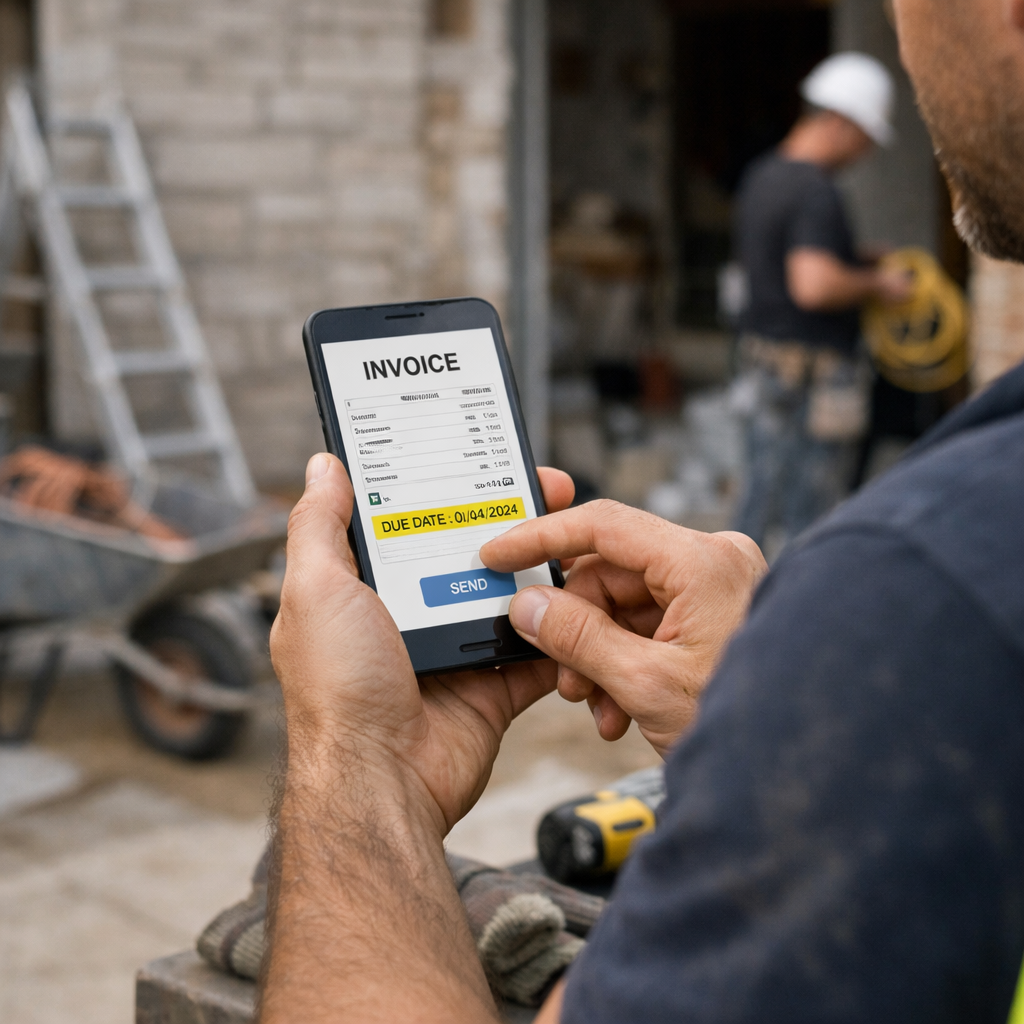
- Due date – not “30 days” in small print, but an actual date in large text
3. Set Short Payment Terms
“30 days” is an office norm borrowed from corporate procurement. It has no place in residential trades. Your costs – fuel, materials, van finance – don’t wait 30 days.
Recommended payment terms by job type:
| Job type | Recommended terms |
|---|---|
| Residential, small jobs | Payment on completion |
| Residential, larger jobs | Balance within 7 days of completion |
| Commercial / business clients | 14-30 days (this is the space where 30 days is standard) |
| Landlords and property managers | 7-14 days |
“Payment on completion” is entirely reasonable for most residential work. State it on every quote so it’s not a surprise on the invoice.
4. Follow Up – Without Apology
Chasing payment makes most tradespeople uncomfortable. It shouldn’t. You’ve done the work. You’re entitled to be paid. Asking someone to honour an agreement they made is professional behaviour, not rudeness.
A simple follow-up sequence:
Day 1 after due date: A light WhatsApp message.
“Hi [name], just checking in – did you get the invoice I sent? Happy to resend if you need it.”
(This gives a face-saving out to genuinely-forgot customers without implying anything negative.)
Day 3-5: More direct.
“Hi [name], I haven’t received payment for the [job] yet. Could you let me know when this will be sorted? Thanks.”
Day 7-10: Formal.
Send a written reminder via email or letter with “Overdue Invoice” in the subject line, referencing the invoice number and amount.
Beyond 14 days overdue: Consider a formal letter before action. Templates are available free online. This signals you’re serious and often prompts payment before any legal step is needed.
For consistently late-paying commercial clients: add a late payment clause to your terms. Under UK law (Late Payment of Commercial Debts Act), you’re entitled to charge statutory interest on overdue commercial invoices.
5. Make Paying Easy
The harder you make it to pay, the later you’ll get paid.
Ways to reduce payment friction:
- Bank transfer details clearly on the invoice – sort code, account number, payment reference
- QR code linking to your bank payment – tools like Paym or your bank’s app can generate these
- Card payment – a Sumup or Square card reader costs under £30 and means customers can pay on the spot at job completion
- PayPal or Stripe – for customers who prefer digital payments
- A phone call – the most underrated tool. Some customers just need a conversation. A brief call on day 2 of an overdue invoice often resolves it faster than any message
6. Protect Yourself on Larger Jobs With Stage Payments
For jobs running over multiple days or weeks, waiting until completion to invoice the full balance is a risk. A customer who runs into financial difficulty, changes their mind about the spec, or simply becomes awkward is less manageable when they owe you everything at the end.
Example stage payment structure for a £8,000 kitchen fit:
| Stage | Amount | Trigger |
|---|---|---|
| Deposit | £2,000 (25%) | Before materials ordered |
| First stage | £2,000 (25%) | On delivery of units/materials |
| Second stage | £2,000 (25%) | On completion of fitting |
| Final balance | £2,000 (25%) | On completion and sign-off |
Stage payments are common on larger jobs and customers who’ve worked with contractors before will expect them. For those who haven’t, a brief explanation – “this is how we manage cash flow on larger projects” – is usually sufficient.
Dealing With Customers Who Refuse to Pay
Despite the best systems, occasional non-payment happens. Here’s the escalation path:
- Formal written reminder – recorded delivery letter, stating amount owed, original invoice date, and deadline to pay before further action
- Letter Before Action – states your intention to pursue through the courts if not paid within 14 days. Free templates available from Citizens Advice
- Small Claims Court – for amounts up to £10,000, the process is straightforward and relatively low cost. You can file online at gov.uk. The court issues a judgement which can be enforced
- Debt collection agency – as an alternative to court, for a percentage of the amount owed. Often effective without legal proceedings
Prevention is far better than cure. A deposit, clear terms, and prompt invoicing eliminates the vast majority of payment problems before they start.
Conclusion
Getting paid on time is not about being aggressive – it is about being organised. Set your terms clearly, invoice promptly, follow up systematically, and the vast majority of customers will pay on time without any awkwardness. The ones who don’t will have made that clear early, which is useful information. For further guidance, visit Late Payment of Commercial Debts Act.
Frequently Asked Questions
Is it legal to charge interest on late invoices?
For commercial clients (businesses, landlords, property managers), yes – under the Late Payment of Commercial Debts Act, you’re entitled to claim statutory interest of 8% above the Bank of England base rate on overdue invoices. For private residential customers, you can include a late payment charge in your terms, provided it was clearly stated before the work commenced.
Should I stop work if a customer isn’t paying on a multi-stage job?
Yes – calmly and professionally. If a milestone payment isn’t received as agreed, it’s reasonable to pause work until the account is brought up to date. State this in your terms so it’s not a surprise: “Work will pause if any stage payment becomes more than [X] days overdue.”
What’s the best way to handle a customer who disputes the invoice?
Respond in writing, calmly. Ask them to specify exactly what they’re disputing. If there’s a genuine error, correct it. If the dispute is unreasonable, refer to your written quote and any variation agreements. Most disputes are resolved by this process. If not, mediation or small claims court are the next steps.
Should I accept cash?
You can, but issue a receipt and record it properly. Cash that disappears into a personal account and never appears in your tax records is tax evasion, which is a criminal offence. Cash is fine – just treat it like any other income.
How do I set up bank payment details on my invoices?
Your sort code, account number, and a suggested payment reference (usually the invoice number or your name). Most bank apps let you share your details as a standard block of text. Some have a “request payment” feature that generates a link. Kwowta includes your bank details on every invoice automatically once you’ve set them up.
What if I’m owed money by a customer who’s died or gone bankrupt?
These situations are more complex. For deceased estates, contact the executor in writing – you may be a creditor of the estate. For bankruptcy, you’ll need to register as a creditor with the insolvency practitioner. In both cases, recovery is not guaranteed – which is why deposits and stage payments on larger jobs are so important as protection.