
What Qualifications Do You Need to Be a Solar Installer in the UK?
Solar installation sits at the intersection of electrical work, roofing, and energy systems – and the qualifications reflect that. Unlike some trades where you can start with minimal formal training, solar installation has a well-defined qualification pathway that you need to follow correctly, both for legal compliance and commercial viability.
Here’s exactly what you need.
The Core Electrical Foundation
Solar PV installation is classified as notifiable electrical work under Part P of the Building Regulations. This means the person carrying out the electrical elements must either:
- Be registered with a competent person scheme (NICEIC, NAPIT, ELECSA), or
- Have the work inspected and certified by building control
In practice, every solar installer must have – or work under – a qualified electrician with competent person scheme registration. The baseline electrical qualifications are:
18th Edition IET Wiring Regulations (BS 7671) The current edition of the UK wiring regulations. Required for any electrician doing domestic or commercial work. Assessed by C&G 2382-22. Renewed every few years when a new edition is published.
NVQ Level 3 in Electrotechnical Technology (or equivalent) The standard electrician’s trade qualification. If you have this (or a recognised equivalent from an apprenticeship), you have the foundation for solar work.
City & Guilds 2391 (Inspection and Testing) Electrical inspection and testing certification. Required for commissioning and certifying electrical installations including solar PV systems.
Solar-Specific Qualifications
On top of the electrical foundation, solar-specific training is required for MCS certification:
City & Guilds 2399 – Solar PV Installation The primary solar-specific qualification. Covers system design, component selection, installation methods, commissioning, and handover. Offered by training providers nationwide. Costs approximately £500-900 for the course and assessment.
City & Guilds 2919 – Electrical Energy Storage (Battery) Required for installing battery storage systems. Covers battery technology, system design, safety, and commissioning. Increasingly essential as battery add-ons become standard.
City & Guilds 2921 – EV Charging Required for EV charger installation and OZEV grant eligibility. A natural complement to solar for businesses wanting to offer a full clean energy package.
Working at Height
Solar installation involves working on roofs. Relevant certifications:
IPAF (International Powered Access Federation) Required for use of mobile elevated work platforms (MEWPs) – cherry pickers, scissor lifts. Valid for 5 years.
PASMA (Prefabricated Access Suppliers’ and Manufacturers’ Association) Required for mobile scaffold towers. Often used alongside or instead of IPAF for solar access.
Harness and fall arrest training Required for any work using personal fall protection equipment on roofs. Various training providers; typically a one-day course.
Most solar businesses use scaffolding erected by a subcontracted scaffolding company for standard residential installs, which reduces the need for IPAF/PASMA on every job – but having these qualifications is still good practice.
MCS Certification Requirements
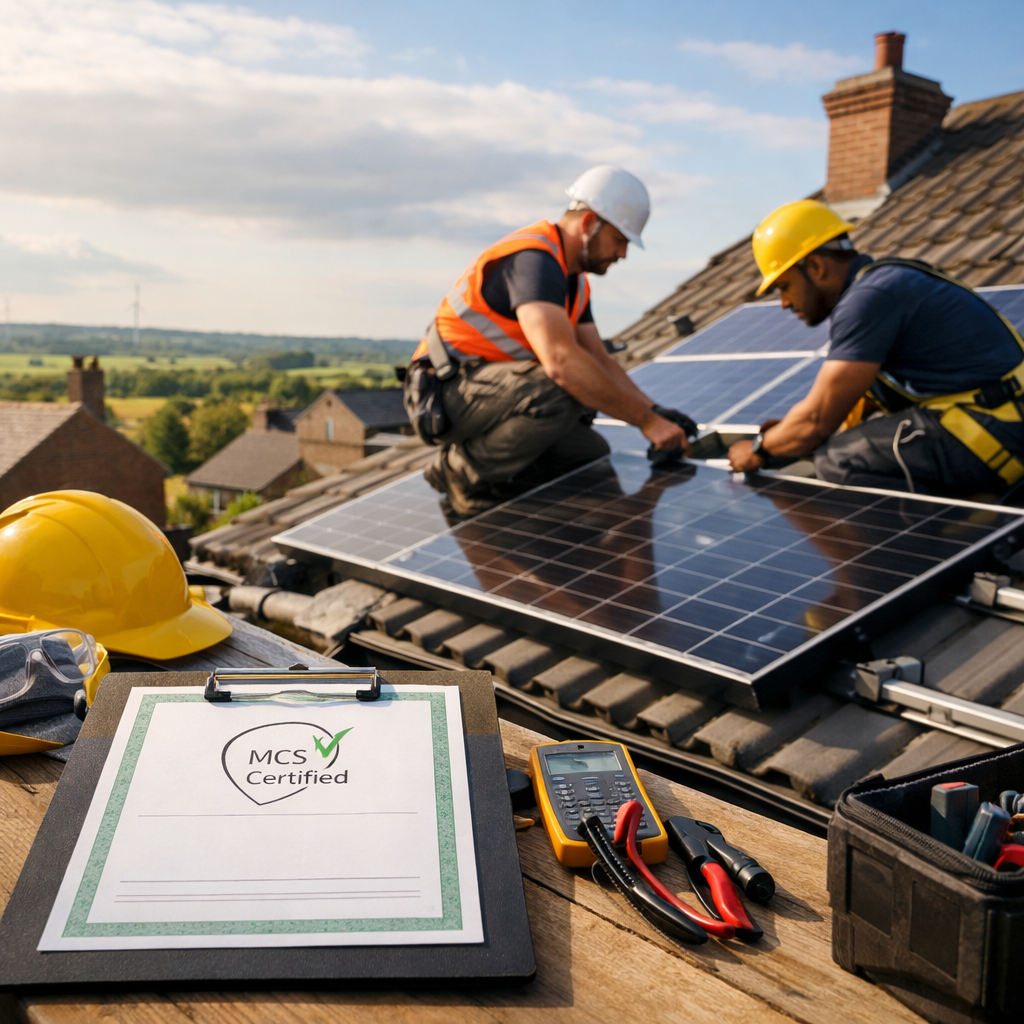
MCS certification (Microgeneration Certification Scheme) is the industry standard for solar installers in the UK. It’s not a qualification per se – it’s a company accreditation that certifies your business meets quality standards. But it has qualification prerequisites:
| MCS requirement | Detail |
|---|---|
| Relevant electrical qualifications | As above |
| C&G 2399 (Solar PV) | Or equivalent MCS-recognised training |
| C&G 2919 (if offering battery) | Required for each product category |
| Registered with competent person scheme | NICEIC, NAPIT or similar |
| Company quality management system | Documented procedures for site assessment, design, installation, commissioning |
See mcscertified.com for full certification criteria.
RECC Membership
The Renewable Energy Consumer Code (RECC) is an optional but commercially valuable consumer code membership. It provides:
- Consumer protection framework that gives customers confidence
- Access to RECC’s dispute resolution service
- A marketing badge that signals credibility
RECC membership is required to access some grant funding streams and housing association frameworks. Worth getting alongside MCS.
Qualification Pathways by Background
| Your background | What you need to add |
|---|---|
| Qualified electrician (18th Ed + NVQ3) | C&G 2399, working at height training, MCS |
| Roofer with no electrical | Partner with qualified electrician OR study full electrical qualification pathway (2+ years) |
| Electrical apprentice | Complete apprenticeship, then add C&G 2399 and working at height |
| No relevant background | NVQ3 electrical (apprenticeship or adult route), then solar-specific qualifications – 3-4 years minimum |
The fastest route is an existing qualified electrician adding solar-specific training. The full pathway from scratch is 3-4 years.
Conclusion
Qualifications and registrations are an investment in the long-term credibility of your business. Customers are increasingly checking credentials before they hire, and the trades that are fully certified consistently win better work at better prices than those who are not. For further guidance, visit MCS Certification.
Frequently Asked Questions
How long does it take to become a qualified solar installer?
If you’re already a qualified electrician, add 4-8 weeks for solar-specific training (C&G 2399) plus 8-16 weeks for MCS certification. From scratch, allow 3-4 years for the electrical apprenticeship before adding solar qualifications.Is City & Guilds 2399 the only recognised solar qualification?
C&G 2399 is the most widely accepted, but MCS publishes a list of accepted training including BPEC and other awarding bodies. Check current MCS requirements before booking training.Can a roofer install solar panels without an electrical qualification?
A roofer can carry out the mechanical installation (mounting brackets, panel placement) but cannot carry out or certify the electrical work. A joint venture between a roofer and an electrician is a viable model, but both must be clear about their roles and responsibilities.Do I need qualifications to install solar panels on my own home?
Legally, any competent person can install solar on their own home, but the installation must either be self-certified by a competent person scheme member or notified to building control. For the installation to qualify for SEG payments, it must be MCS-certified.Related reading: